 High Desert Desk
After the Ridge Walk, One Milliliter of Oregon Hawthorn in Warm Water
Oregon's Wild Harvest makes this extract of hawthorn berry, leaf and flower in Redmond, on Oregon's high desert. I read its label the way I walk the ridge: one marker at a time, from the trailhead up.

This is a paid advertisement. Sponsored by Oregon's Wild Harvest, Inc.
The name at the top, Virgil Tanner, is one our writers share, and the ridge walk in this story is drawn from the mornings of several of them.
Hollis, the friend who walks it with me, is a composite as well, and nothing on this page describes a result of his.
What the page says about the bottle comes from its label, the seller's listing, the seller's terms and published sources.
I read all of them in September 2026.
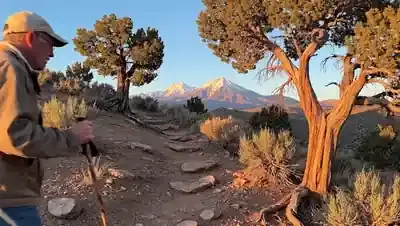
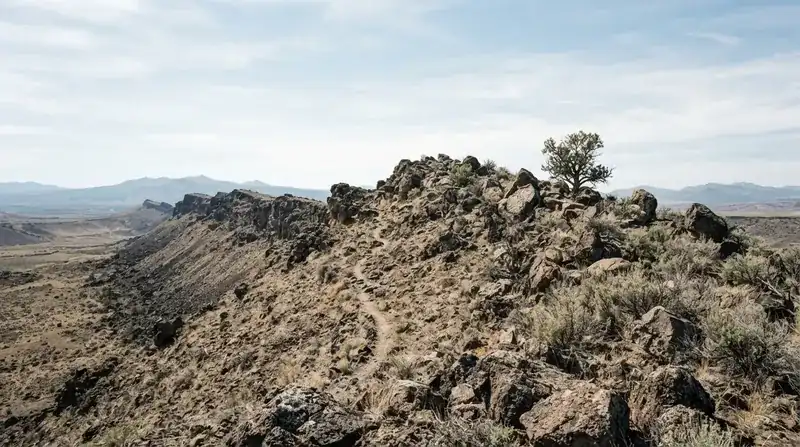
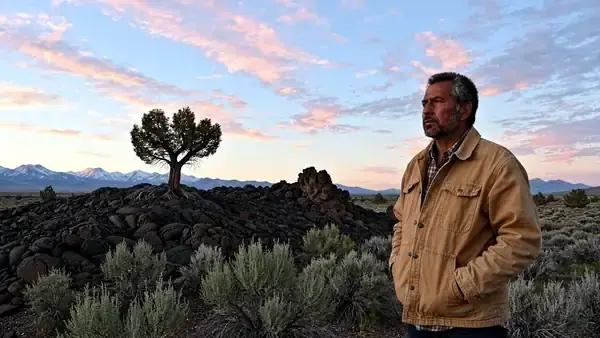
There's a dirt road above town that climbs to a ridge of old lava rock.
Juniper on both sides, sagebrush in between, and on a clear morning the snow peaks stand along the western sky like a row of teeth.
Hollis and I walk it most mornings, a little after six.
We've done it long enough that the road has names for its parts: the cattle guard, the washout, the big juniper, the bench, the top.

The talk on the way up is never about anything important.
Fence posts, the price of hay, whose grandkid is playing ball where.
But this spring, somewhere between the washout and the big juniper, Hollis stopped talking.
Not because anything was wrong, but because the grade had taken his breath for a minute and he wanted it back.
He laughed about it at the bench.
"This hill got steeper," he said, "and nobody told me."
The hill hasn't changed in a thousand years. We have, a little, and that's allowed.
A week later he showed up at the cattle guard with a small amber bottle in his jacket pocket.
He'd picked it up at the grocery co-op in town, and the label said Hawthorn in big purple-blue letters.
"You're the one who reads the fine print," he said.
"Read this one and tell me what I'm putting in my water three times a day."
So that's what this page is.
It's one bottle, read the way I walk the ridge: one marker at a time, from the trailhead to the top, with the view described honestly at every turn.
It isn't a verdict, and it isn't medical advice. It's a slow reading of a small bottle, by someone who likes to know what he's carrying before he carries it.
By the time we reach the top, you'll know what's in it, how long it lasts, what it has been measured against, and where the measurements stop.
And you'll know what's on the ridge that costs nothing at all.
Two Miles of Road, and the Stretch That Got Longer
Let's start where Hollis started, at the bench, catching his breath.
Not with the bottle, but with the reason a man our age picks one up.
Is a steeper-feeling hill something to worry about? For most of us, it's the ordinary price of the years.
Legs, lungs and heart have been doing the same job for six or seven decades, and they've earned a slower pace on the grade.
You know the small signs, because everybody over sixty knows them.
The bench you used to walk past is now the bench you sit on for a minute.
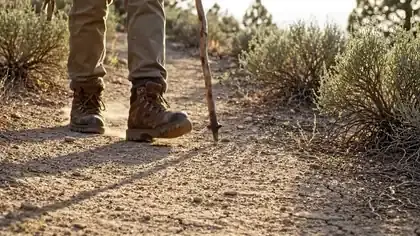
You stop to retie a boot, and you're glad of the excuse.
The last stretch takes a few more breaths than it did at fifty.
None of that is a verdict on your health, and I'm not going to dress it up as one.
It's the plain experience of a body that has carried you a long way.
If something changes suddenly, or a walk you've done for years stops feeling ordinary, that's a question for a clinician, not for a bottle.
This page is about the ordinary kind.
Then why do so many of us start looking at bottles? Because we'd like to keep walking the ridge for a long time.
Because a wife, a daughter or a friend worries, and a small daily habit is a way of saying we're paying attention.
Those are good reasons to be curious.
They're not reasons to stop reading the label.
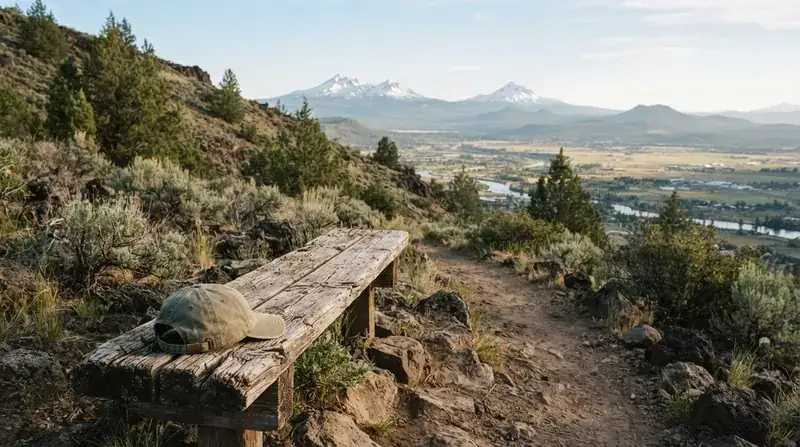
At the bench, the view opens up to the west.
On a clear day you can count the peaks, and Hollis always does, out loud, like a man making sure nobody has moved them since yesterday.
How do you tell an ordinary pace from a hard one? There's a simple check that the CDC describes.
During moderate activity, you can talk but not sing; during vigorous activity, you can't say more than a few words without pausing for a breath. [1]
By that measure, the washout is moderate for both of us, and the last stretch before the bench is somewhere near the edge.
That's useful to know, and it cost us nothing to find out.
The CDC counts brisk walking at 2.5 miles per hour or faster as moderate intensity. [1]
For most men our age, that's a steady pace on the flat and a slower one on the grade.
Talk but not sing. That's the whole test, and it fits in a jacket pocket.
I'm telling you this first for a reason.
When a new bottle shows up, it's easy to forget how much we already know about keeping the legs and the heart going.
What We Already Do on the Way Up
Before anything new goes in the pocket, I always look at what's already working.
Most of us have a system for the ridge, even if we've never written it down.
Does the walk itself count? More than anything else on this page.
The federal activity guidelines set a weekly range of 150 to 300 minutes of moderate activity, such as brisk walking, spread through the week, plus muscle-strengthening work on two or more days. [2]
Our road, up and back, is a bit under an hour at our pace.
Five mornings of that is about 250 minutes, which lands us inside that range without any arithmetic beyond counting.
What if a man can't do an hour? Then he does what he can, and it still counts.
The guidelines dropped their old ten-minute minimum in 2018, so bouts of any length count toward the week, even climbing a few flights of stairs. [3]
They also say that 10,000 steps a day is popular advice, not a guideline.
Their own example is to add a 20-minute walk, about 2,000 steps, to a usual day of about 5,000 steps. [3]
Is there anything special for men past sixty? Two things, both sensible.
The guidelines add balance work for older adults, and they ask each of us to judge our effort against our own fitness, not a younger man's. [4]
That second part matters on a ridge.
Hollis is faster on the flat and I'm steadier on the loose rock, and both of us are doing it right.
Your effort, measured against your own legs. Nobody else's.
What about the plate? The current Dietary Guidelines set a goal of 3 servings of vegetables and 2 of fruit a day on a 2,000-calorie pattern, eaten whole. [5]
They name olive oil, omega-3-rich seafood, nuts, seeds and avocados among sources of healthy fat, and they suggest baking, grilling or roasting instead of deep-frying. [5]
And the cup? The same guidelines advise water and unsweetened drinks, and less alcohol for better overall health. [6]
They advise avoiding sugary sodas, fruit drinks and energy drinks, and keeping juice to limited portions or diluting it with water. [6]
And the yearly visit? That's the one piece nobody can do on a trail.
The American Heart Association scores eight components of heart health: four are daily habits, and the other four are measurements of the body best checked with a clinician. [7]
Half of that score is made on the trail and at the table. The other half is made in the exam room, once a year.
So where does all that stop? It stops at the part most of us want in addition, not instead.
A small daily ritual, something in a glass, a plant with a long history behind it.
That's how Hollis ended up with a bottle of hawthorn.
And that's where a careful reading earns its keep, because the shelf he found it on has a lot of hawthorn, and very little of it is labeled the same way.
A Shelf of Hawthorn in Four Different Units
If you've never looked, the hawthorn shelf is a small puzzle.
The same plant shows up in four or five forms, and each one is measured in its own unit.
What forms are there? Tea bags and loose tea, measured in grams of dried plant.
Capsules, measured in milligrams of powder or of a dried extract.
Syrups, measured in teaspoons.
And liquid extracts like Hollis's bottle, measured in milliliters, with a ratio printed somewhere on the label.
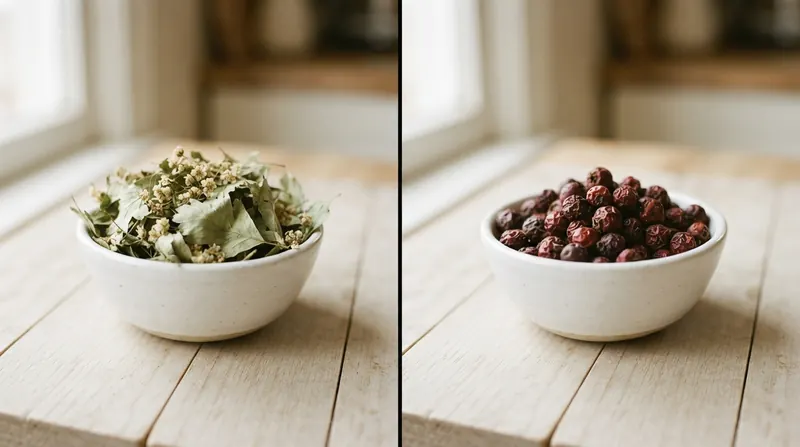
Why does the unit matter? Because you can't compare a gram of dried leaf with a milliliter of liquid unless you know how much plant went into the liquid.
That's what the ratio is for, and most people skip right past it.
There's a second puzzle on top of the first.
Hawthorn products don't all use the same part of the plant.
Some use the berries, which ripen in the fall.
Some use the leaves and flowers, which are cut in spring, and some use a mix of both.
As we'll see a little further up the trail, those parts are chemically different.
So two bottles that both say "hawthorn" on the front can hold rather different things.
Same word on the front. Different plant part, different unit, different amount.
None of this means one form is good and another bad.
It means the front of the bottle can't tell you much, and the side panel has to do the work.
Which form did Hollis pick, and why? The liquid, because it sat at eye level and because he doesn't like swallowing capsules.
That's how most of us choose, and there's nothing wrong with it, as long as the reading comes after.
So here's how I read a side panel.
It's the same way we read the road: by markers.
The Six Cairns I Look For on Any Label
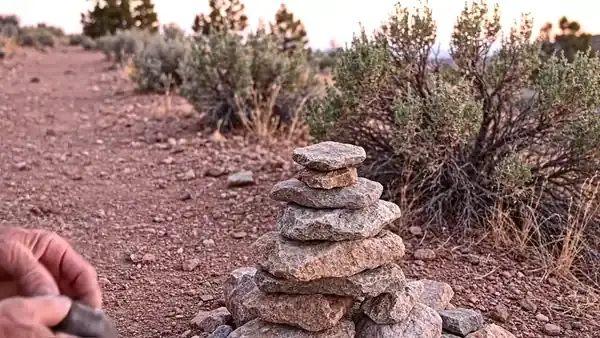
On a trail where the path fades out over rock, somebody always builds cairns.
Small stacks of stones, one within sight of the next, so the walker behind them doesn't have to guess.
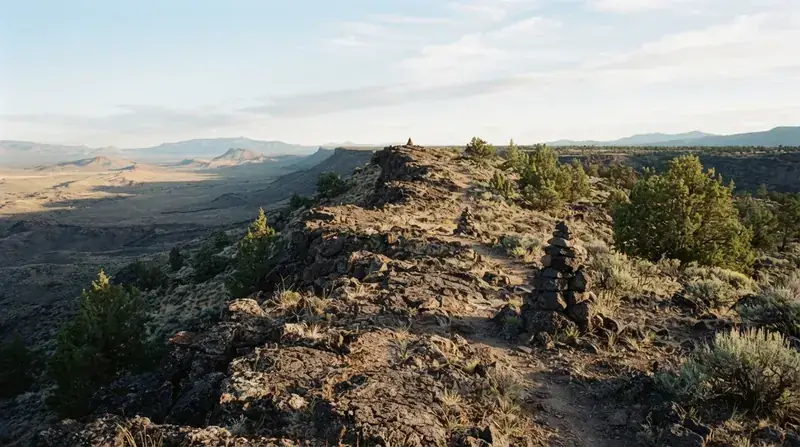
I read labels the same way, with six cairns, one after another.
If one is missing, I stop and look around before I go on.
Cairn one: which part of the plant? Berry, leaf, flower, root.
The part decides the chemistry, and the chemistry decides what any study can tell you.
Cairn two: how much plant is in one serving? Not how much liquid, but how much plant went into it.
With an extract, that means reading the ratio, and doing one line of arithmetic.
Cairn three: how does one serving compare with a reference amount? Is there an official amount for this plant anywhere?
If there is, how close does the label come to it, measured in the same unit?
Cairn four: what has actually been measured in people? Not in a test tube, not in a rat, but in people.
And if it was measured in a test tube or a rat, I'll say so.
Cairn five: what does it cost me in days? How long does one bottle last at the dose the label prints?
That's the number that turns a small price into a monthly one.
Cairn six: who's behind it, and what happens if I don't like it? A name, an address, a telephone number, and the return terms in writing.
That last cairn is the one people forget until they need it.
Six stacks of stones. Most labels answer three of them, and the good ones answer five.
One more thing before we look at the plant and the bottle.
Every number I give you from a study, I'll give you with its size and its subjects, because a test on isolated tissue and a trial in a thousand people aren't the same kind of marker.
The Shrub on the Hillside Before It's in a Bottle
What is hawthorn, exactly? It's a flowering shrub or small tree of the rose family that grows in temperate regions throughout the world. [8]
You've likely walked past it without knowing its name: thorny branches, lobed leaves, white blossoms in spring and small red berries in the fall.
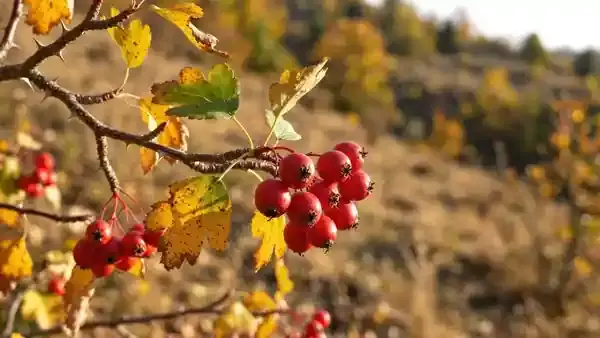
The berries have been eaten for a long time.
A 2012 review of hawthorn's chemistry notes that Native American tribes ate the fruit as food, and that hawthorn has a long history as a food in Europe and in China. [9]
That's worth writing down at the first cairn.
Before hawthorn was anything else, it was a berry that people picked and ate.
What makes it interesting to researchers? Mostly two families of plant compounds.
The same review says research on hawthorn focuses mainly on its flavonoids and anthocyanins, and that its main flavonoids are hyperoside, vitexin and their relatives. [9]
Those names will come back a couple of times on this walk.
You don't need to remember them, only that they exist and that the amounts differ from one part of the plant to another.
The review adds a caution that matters for every bottle on the shelf.
The chemistry varies between species. [9]
There are many kinds of hawthorn, and a label that says only "hawthorn" tells you the genus, not the species.
Keep that in your pocket, because the bottle in this story names the genus and leaves the species open.
A plant with a long food history, a well-studied chemistry and many species. That's the hawthorn at the trailhead.
Is there anything to watch out for before we even look at a bottle? One thing, and it has nothing to do with the bottle in Hollis's pocket.
The Food and Drug Administration has flagged several hawthorn root products labeled "tejocote root" that actually contained yellow oleander, a toxic plant. [8]
Those were root products, sold under another name.
The lesson for any buyer is simple: choose a maker who names the plant part on the label, and a company you can call.
Berry in Autumn, Leaf and Flower in Spring
Why does the plant part matter so much? Because the berry and the leaf don't carry the same compounds, or the same amounts of them.
It's the part of any hawthorn label that the front can't show you.
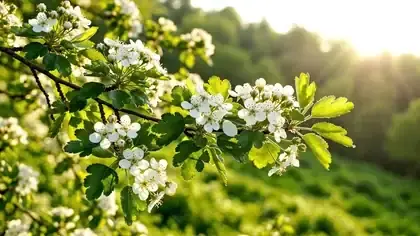
What did the chemists find? In one analysis of a North American hawthorn, the leaves held far more hyperoside than the fruit: about 2 to 11 milligrams per gram of dry weight, against 0.5 to 1 milligram. [10]
The leaves also held 2 to 5 milligrams per gram of the vitexin family of flavones, which appeared only in traces in the fruit. [10]
So is the leaf simply better? Not so fast.
In the same analysis, both leaves and fruit held epicatechin and two procyanidins at milligrams per gram. [10]
So the berry isn't an empty version of the leaf.
It's a different mix, with some compounds shared and others mostly missing.
What about the flower? A second analysis compared the buds, flowers and fruits of a European hawthorn at three stages of ripeness. [11]
The flowers held the most vitamin C and vitamin E, the over-ripe fruits the most sugars, and the unripe fruits the most phenolic compounds and the strongest antioxidant activity in laboratory tests. [11]
Leaf, flower and berry: three parts of one shrub, and three different chemistries.
Is there an official standard for any of this? For leaf and flower, yes.
The European Pharmacopoeia requires dried hawthorn flowering branches to contain at least 1.5% total flavonoids, expressed as hyperoside. [12]
Europe's assessment of leaf and flower lists flavonoid glycosides, catechin, epicatechin, procyanidins and some organic acids among its main constituents. [12]
There's no equivalent official standard for the berry in the sources I read.
What does that mean for a buyer? It means a label that names the part is telling you something real.
And a label that holds two parts without saying how much of each leaves you guessing which chemistry you're getting.
One more honest note from these analyses.
They are studies of the plant, not studies in people, and one of them used a North American species that may not be the one in any given bottle. [10]
Plant chemistry tells you what's in the leaf or the berry. It doesn't tell you what reaches you after you swallow it.
We'll come to that marker after we've looked at the bottle.
With the plant in mind, here it is.
A Small Amber Bottle From Redmond, Oregon
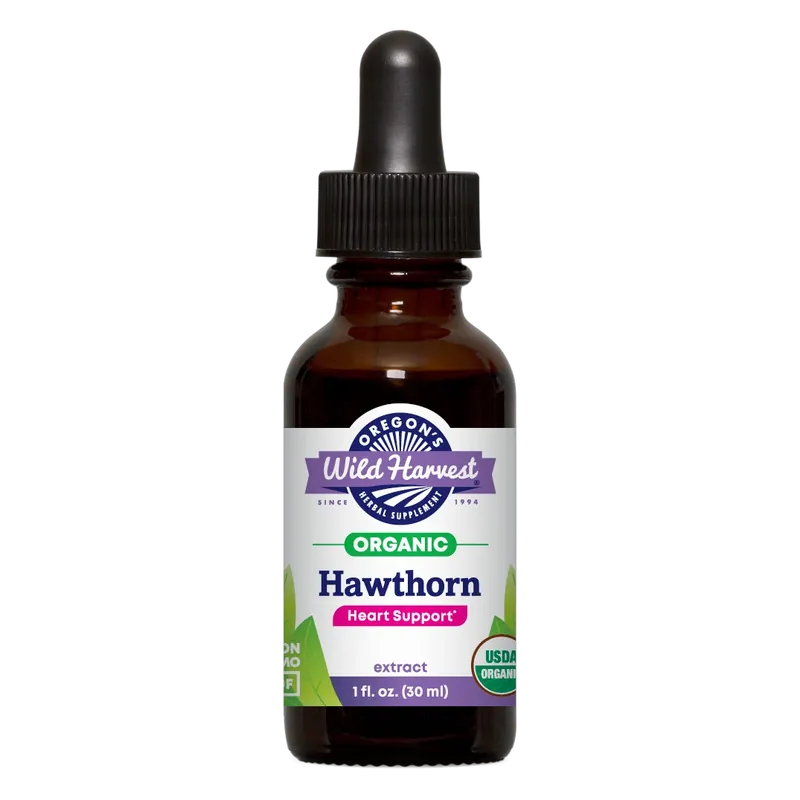
The bottle Hollis handed me is called Organic Hawthorn, and it's made by Oregon's Wild Harvest.
It's a one-ounce amber glass bottle, 30 milliliters, with a glass pipette in a black cap.
The company is in Redmond, a town in the high desert of Central Oregon, on the dry side of the mountains.
The label says "Since 1994," and the company describes itself as certified organic since that year.
Who's behind it, exactly? The company's legal name is Oregon's Wild Harvest, Inc., and its terms list an address on NE Hemlock Avenue in Redmond.
It prints a telephone number, (800) 316-6869, on its website, in its terms and on the label itself.
That's cairn six, answered before we've read a single ingredient.
A maker whose phone number is on the bottle is a maker you can ask a question.
What does the front say? In large letters: "Organic," "Hawthorn," and underneath, "Heart Support" with an asterisk.
The asterisk points to the standard statement about the Food and Drug Administration that supplement labels of this kind carry.
Here's the first thing a careful reader notices.
"Heart Support" is how the maker describes the product, not a result anyone measured in this bottle.
The Side Panel, Copied Onto the Trail Map
Now turn the bottle, the way you'd turn a trail map to read the legend.
The side panel is where the real reading starts.
What's the serving? One milliliter.
The label adds its own conversion: "1 mL = approx. 40 drops."
How many servings in the bottle? The panel says thirty.
Keep that number handy, because it's about to do something interesting.
What's in one serving? The panel lists an "Herbal Proprietary Blend," 500 milligrams, with two lines under it.
Organic hawthorn berry, and organic hawthorn flower and leaf, both listed as Crataegus without a species.
What else is in it? Organic alcohol and distilled water.
The panel adds, "Alcohol Content: Not more than 55%."
Does the panel say how much is berry and how much is leaf and flower? No.
Both parts sit inside one 500-milligram blend, and the label gives no split between them.
Could you ask the maker? You could, and I would.
"Roughly how much of the 500 milligrams is berry?" is a fair question for a company that prints its number on the bottle.
What are the directions? In the label's own words: "Take 1 mL three times daily in warm water or juice or as directed by your healthcare professional."
Then: "Do not exceed recommended dose," and, "Shake well. Store upright in a cool, dry place."
Any other lines worth copying? The label says to keep it out of reach of children and not to take it if you're pregnant or breastfeeding.
It asks anyone who takes anything daily to check with a healthcare professional first, and to stop if anything unusual occurs.
Serving, count, blend, ratio, directions, cautions. Every one of those lines matters on this walk.
Thirty Servings Is Ten Days on the Trail
Here's where Hollis's bottle made me stop at the bench and read it twice.
The panel says thirty servings, and the directions say three a day.
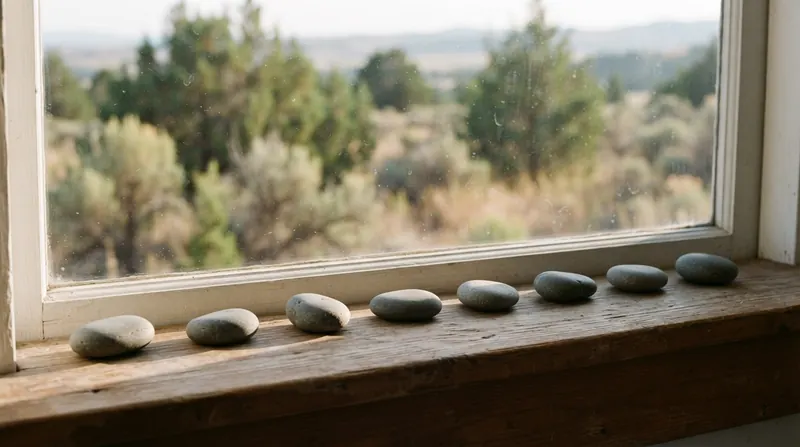
So how long does a bottle last? Thirty servings divided by three a day is ten days.
Not a month, not three weeks: ten mornings, ten middays and ten evenings.
But most of us read "30 servings" and think "a month."
On this bottle, a month at the printed dose is three bottles.
Thirty servings, three a day. Ten days, not thirty.
Why does that matter? Because the price on the shelf is the price of ten days.
If you're weighing it against a monthly budget, multiply whatever you see by three.
I'm not printing the price here, because the seller sets it and it can change.
The seller also offers a subscription at a discount beside the button, but for a first try I'd buy a single bottle.
Could you take more to catch up, or less to stretch it? More, no: the label says plainly, "Do not exceed recommended dose."
Less, you could, but then you're not following the label, and you should know that before you call it the same thing.
Cairn five, answered: ten days a bottle, three bottles a month, at the dose on the label.
One Part Plant, Two Parts Liquid
Now for the cairn most people walk right past.
The listing prints two characters that tell you more than anything on the front: 1:2.
What does 1:2 mean? One part of plant for every two parts of liquid.
One gram of hawthorn, extracted into two milliliters of alcohol and water.
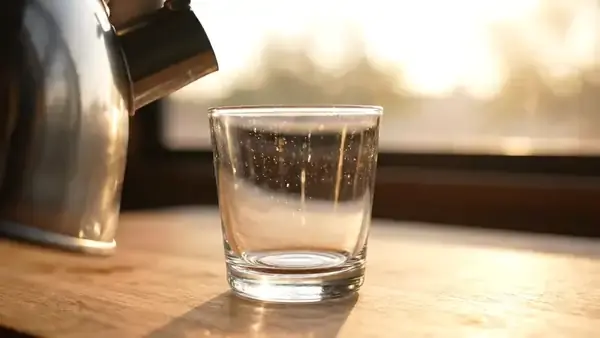
Do the arithmetic, and each milliliter carries the extract of about half a gram of plant, or 500 milligrams.
That matches the panel's blend of 500 milligrams, so the numbers agree with each other.
How much plant in a day, then? Three milliliters a day is about 1.5 grams of hawthorn.
That's berry, leaf and flower together, in proportions the label doesn't give.
Is 1.5 grams a lot? By itself, the number can't tell you.
A number on its own is a rock on the trail; a reference amount turns it into a marker.
Halfway Up Europe's Ridge
The European Union keeps what it calls herbal monographs: official summaries of how a plant is prepared and in what amounts.
The one for hawthorn leaf and flower was adopted by the European Medicines Agency's herbal committee in 2016. [13]
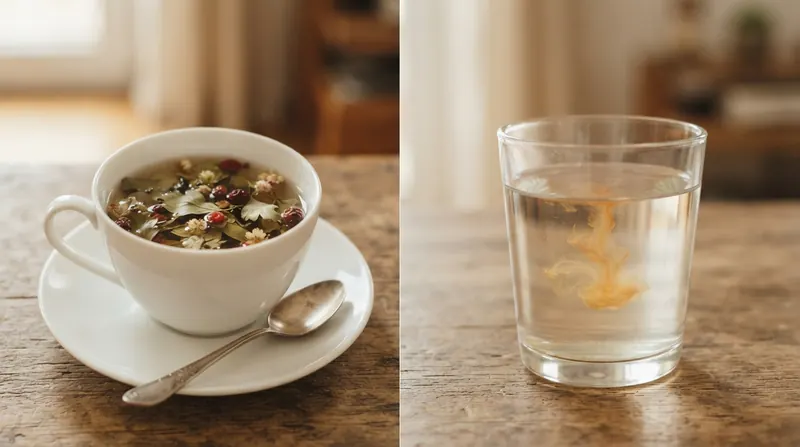
What amounts does it list for adults? For a tea, 1 to 2 grams of cut, dried leaf and flower in 150 milliliters of boiling water, up to four times a day, and at most 6 grams a day. [13]
For a liquid extract made 1:2 with 45% ethanol, the same ratio as Hollis's bottle, it lists a single dose of 1.84 grams and a daily dose of 5.52 grams. [13]
Now, here's the trap, and I nearly stepped in it myself.
Those 5.52 grams are grams of finished liquid extract, not grams of plant.
So how do you compare them fairly? You put both in the same unit.
A 1:2 extract carries one part of plant for every two parts of liquid, so 5.52 grams of it comes from about 2.76 grams of leaf and flower.
Hollis's three milliliters a day come from about 1.5 grams of plant.
Measured the same way, that's a little more than half of the monograph's daily amount.
About halfway up Europe's ridge. Not the top, and not the trailhead.
Does halfway mean it's too little? Not necessarily, and I want to be careful here.
The monograph and the bottle don't describe the same thing, and three differences keep the comparison approximate.
- The monograph covers leaf and flower only; this bottle mixes in berry, in a proportion the label doesn't give.
- The monograph's extract uses 45% ethanol; this one uses up to 55% alcohol and water.
- The monograph lists its amounts under a use that this page doesn't discuss, and a reference amount isn't a trial result.
Should Hollis take six milliliters, then, to reach the top? No.
The label says not to exceed the recommended dose, and a reference amount in Europe doesn't change the directions on an American bottle.
And compared with a cup of tea? One milliliter comes from about half a gram of plant.
The smallest European cup uses 1 gram of dried leaf and flower, so one serving is about half of the smallest cup. [13]
The monograph adds cautions of its own.
It doesn't recommend use during pregnancy or breastfeeding or in children, and it asks that a clinician be consulted if anything unexpected occurs. [13]
What the Research Has Measured, and Where the Trail Ends
This is the stretch I walk slowest, because it's where a lot of advertising takes shortcuts.
So let's take it one marker at a time.
What does the federal government say about hawthorn in people? The National Institutes of Health's center for complementary health says there is little or no quality evidence on hawthorn for most uses. [8]
It says short-term use of some hawthorn supplements may pose little risk, but no studies have tested use beyond 16 weeks. [8]
What side effects does it list? Dizziness, nausea, vomiting, diarrhea and muscle aches. [8]
It adds that little is known about use during pregnancy or breastfeeding. [8]
That's the most important marker on this page, so I'll say it plainly.
The human evidence on hawthorn, for most of what people buy it for, is thin.
What about how the body handles it? Here the trail starts to fade.
Europe's assessment report says only a few studies have looked at how the body absorbs and clears hawthorn's compounds, so that remains largely unknown. [14]
One study it cites measured an oral bioavailability of only 3.57% for vitexin rhamnoside, a flavonoid typical of the leaf. [14]
In rats, two vitexin compounds peaked in the blood within 45 minutes, had half-lives of about two and a half hours and weren't found in brain tissue. [14]
A more recent set of cell and rat experiments found the same pattern.
The main flavonoids of hawthorn leaf crossed the gut lining poorly, hyperoside a little better than the rest. [15]
Plenty in the leaf. Not much of it, as far as anyone has measured, gets through.
Is there anything on blood vessels? One laboratory study, and it's worth reading carefully.
Researchers tested twenty-one compounds found in hawthorn or formed from it in the body on isolated blood vessels from pigs and rats. [16]
Two of the twenty-one widened the vessels, but only at concentrations far above the levels typically measured in human blood. [16]
It tells you something in the plant can act on a vessel in a dish, at a high enough dose, and nothing about a milliliter in warm water.
Has anyone tested this bottle itself? Not that I could find.
No study has put this blend of berry, leaf and flower, at this ratio and this dose, into anyone.
A long food history, a well-described chemistry, poor absorption where it was measured, and very little human evidence. That's where the trail ends.
Then why would anyone take it? For the same reasons people keep a cup of a traditional plant in their day.
They like the ritual and the plant's long history, and they choose it knowing the evidence is thin.
The Alcohol in a Milliliter
There's one line on the panel I want to measure the way I measured everything else.
"Alcohol Content: Not more than 55%."
How much alcohol is in one serving? At most 55% of one milliliter, or about 0.55 milliliters of alcohol.
That weighs roughly 0.43 grams.
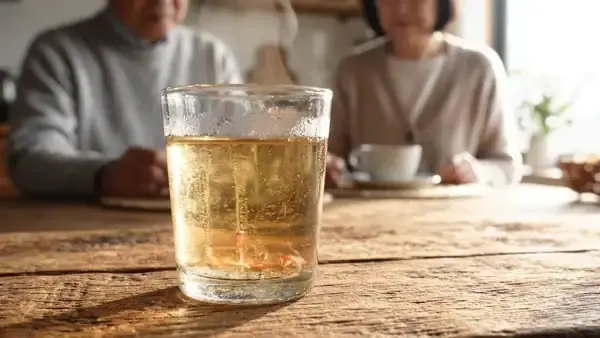
Is that a lot? In the United States, one standard drink holds about 14 grams of pure alcohol: a 12-ounce beer, a 5-ounce glass of wine or a 1.5-ounce shot of spirits. [17]
So one serving carries about a thirty-second of a standard drink, and three servings about a tenth.
For most men, that's a very small amount.
But it isn't zero, and for some people zero is the right number.
Who should think twice? Anyone who avoids alcohol completely, and anyone who takes something daily that shouldn't be mixed with it.
The current Dietary Guidelines say alcohol should be avoided entirely by people who take anything daily that can interact with it. [6]
Does the juice option help? The label allows warm water or juice.
If you choose juice, the same guidelines advise limited portions or diluting it with water, so a splash in a glass of water does the job. [6]
A Day on the Ridge With a Glass of Warm Water
Here's how I'd fit it in, if I were the one trying it.
Nothing fancy, and nothing that pushes anything else out of the day.
When would you take the first one? After the walk, with breakfast.
The label says three times a day, and the easiest way to keep a habit is to hang it on one you already have.
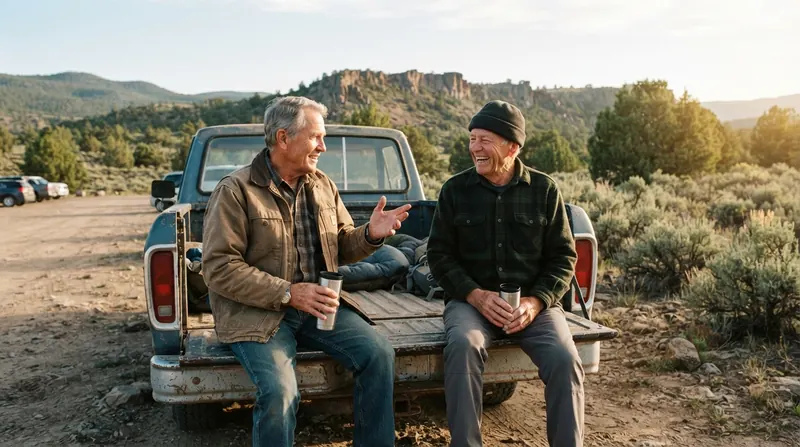
How do you measure a milliliter? With the glass pipette in the cap.
Shake the bottle first, as the label says, then draw up the liquid and let it run into a glass of warm water.
What does it taste like? I can't honestly tell you how it will taste to you.
The label and the listing don't describe it, and none of the four reviews quoted below mentions taste.
When would you take the second and third? Midday and evening, the same way.
Midday can ride along with lunch, and evening with supper.
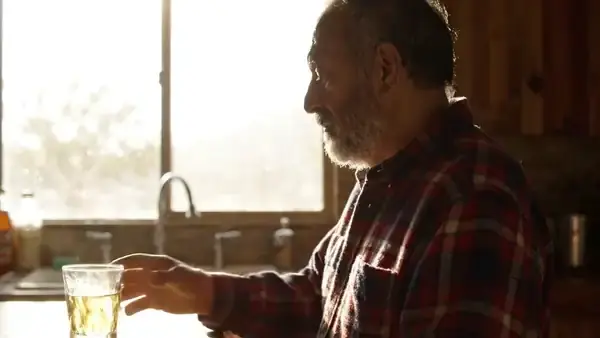
What if you forget one? Then you forget one, and you take the next at its usual time.
The label says not to exceed the recommended dose, so don't double up.
Where does the bottle live? The label says upright, in a cool, dry place.
On our side of the mountains the windowsill gets too much afternoon sun, so a cupboard is the better spot.
One milliliter, three times a day, hung on three habits you already have.
Ten Days, Then Ten More: Pacing a First Try
The ten-day bottle turns out to be handy for one thing.
It gives you built-in markers, the way cairns do.
How would you keep track? One short line a day in a pocket notebook, the way some hikers keep a trail log.
Did I take all three? Did I walk today, and how did the bench feel?
First bottle: the habit. Does three a day actually happen, or does the midday one keep slipping?
Does warm water suit you, or do you prefer a splash of juice?
Second bottle: everything else. By now the warm glass is routine, so look at the other lines: the walks, the plates, the water.
Don't give the bottle credit for a good week of walking.
Third bottle: reading back. Thirty days, ninety glasses, thirty lines in the notebook.
Read them at the kitchen table, the way you'd read back a trail log after a long trip.
When do you need to decide? The seller's return window is 60 days from the order date, about six bottles' worth of time at the label's dose.
That's plenty of room, as long as you write the order date in the front of the notebook.
What if you can't tell anything at all? Then that's an honest answer, and it's worth having.
With a plant whose human evidence is thin, "I can't tell" is a perfectly reasonable place to end up.
Who This Bottle Suits, and Who Should Leave It on the Shelf
It suits a man who wants a small, plain ritual. A glass of warm water three times a day, with a traditional plant in it.
It suits someone who likes a certified organic label, a named plant part and a maker with a phone number on the bottle.
It suits someone who has read the map above and understands the evidence is thin.
And it suits someone who'll keep a notebook for a few bottles instead of guessing.
It doesn't suit a man counting on a bottle to do the work of the walk, the plate and the yearly visit.
Those are the big markers, and nothing in a milliliter replaces them.
It doesn't suit anyone who is pregnant or breastfeeding: the label says not to take it.
It isn't for children, whom the label asks you to keep it away from, and for whom the European monograph doesn't recommend it. [13]
It doesn't suit anyone who avoids alcohol entirely, because a tenth of a standard drink a day is small but isn't nothing. [17]
And it doesn't suit anyone who takes something daily and hasn't asked the pharmacist first.
A small daily ritual works best when you keep it that way: small, daily, and never instead of the big things.
Two Questions for the Pharmacist
The label asks anyone who takes anything daily to check with a healthcare professional before use.
Here's how I'd turn that into five minutes and zero dollars.
Why the pharmacist and not just the label? Because the label can't see what else is in your cupboard.
Your pharmacist can, and it's their job to spot two things that don't belong together.
Put the bottle in a bag with everything else you take daily, including what you buy over the counter.
Set the bag on the counter and ask two plain questions.
- Does anything I take daily argue with a hawthorn extract?
- Does anything I take daily argue with a small amount of alcohol, about a tenth of a drink a day?
Why those two? Hawthorn is sold for the heart and circulation, and the federal summary's own advice is to talk it over first if you take anything regularly. [8]
And the alcohol line is a real line, even if it's a small one. [6]
What if something unusual happens after you start? The label's direction is to stop.
The side effects in the federal summary, dizziness, nausea, vomiting, diarrhea and muscle aches, are exactly the kind of thing to stop for and mention to a clinician. [8]
Five minutes at the counter. It's the cheapest cairn on the whole ridge.
Three Fair Objections
Objection one: "A bottle that lasts ten days is an expensive habit." It can be, depending on your budget.
Look at the price, multiply it by three for a month, and set that beside what you spend on anything else daily.
If it's too much, that's a fine reason to pass.
The walk, the water and the plate cost nothing, and they have far more evidence behind them.
Objection two: "I don't want alcohol three times a day." That's reasonable, and I'd respect it.
A tenth of a standard drink across the day is small, but if your answer to alcohol is none, this isn't your bottle. [17]
Objection three: "There's hardly any research on people." You're right, and I'd rather say so than pretend otherwise.
What's well described is the chemistry and the tradition; what's thin is the human evidence, and no study has tested this bottle. [8]
Shipping, Returns and Two Different Numbers
Here's a marker I always write in red: what happens after you order.
Where does the seller ship? Within the United States only.
Online orders go out within three business days.
Is shipping included? Here the seller's own pages don't agree, and you should know.
The banner at the top of its website says economy shipping at no charge on orders over $60, while its written terms say orders over $50 qualify.
Either way, the offer covers the contiguous United States, so Hawaii, Alaska and the territories are outside it.
If you plan on the higher number, $60, you'll clear both.
What does the seller promise if you're not happy? Its terms offer a return within 60 days of the order date for a comparable replacement or a qualified refund.
You ask for it by phone or by email, and the bottle goes back to the company's address in Redmond.
Is there any catch? Two, and they're worth underlining.
The buyer pays the postage to send it back, and the window only covers purchases made on the seller's own website.
Hollis bought his at the grocery co-op in town, so his bottle is outside it.
If the return window matters to you, order from the seller directly.
Write the order date and the date sixty days later side by side, on the first page of the notebook.
What Four Buyers Wrote
I always read the reviews last, after the label and the research.
Reviews are the part of the trail log written in other people's handwriting.

How many reviews are there? The seller's page showed 11 reviews when I read it, averaging 4.9 of 5: ten at five stars and one at four.
The review system marks every one of the eleven as a confirmed purchase.
Which ones did I leave out? Several describe personal health matters that belong between a buyer and a clinician, so they aren't here.
The four-star review was one of those, which is why all four below are five stars.
Here are four of them, word for word.
They're opinions, not evidence, and the small pictures beside them are illustrations, not the reviewers.

I live most of the time in Europe and loading up on Oregon's Wild Harvest when I am in the US, because your products are the best quality I found so far

I have been using Wild Harvest Hawthorn capsules for a number of years and wanted to include the extract as an additional way to use hawthorn. I am extremely pleased with both the capsule and extract and will continue to use them.

not sure if it works just yet but very good

awesome quality product and shipped quickly will purchase again in the future.
What do I take from them? Lynda's is the one I'd read twice.
"Not sure if it works just yet" is the most honest sentence in the stack, and it matches the map above.
Gudrun and Candy are judging quality and shipping, which are fair things to judge a small company on.
And Judy uses the maker's capsules and added the extract, which tells you the liquid is a choice of form as much as anything.
What Costs Nothing on the Ridge
Before I close the notebook, there's a page I always add at the end.
It's the list of things that belong on the trail and don't cost a dime.
Minutes before steps. Aim for 150 to 300 minutes a week of moderate activity such as brisk walking, spread through the week. [2]
Every bout counts, even a short one, and 10,000 steps is popular advice, not a rule. [3]
A pace you can measure without a gadget. Walk fast enough that you can talk but not sing. [1]
In a study of 98 healthy adults aged 61 to 85, about 100 steps a minute marked the start of moderate intensity. [18]
Strength and balance. Muscle-strengthening work on two or more days a week, [2] and, past sixty, balance work at an effort set by your own fitness. [4]
On a ridge, loose rock and uneven ground are part of every walk anyway.
Water through the day. Water and unsweetened drinks first, fewer sugary drinks and less alcohol, by the current Dietary Guidelines. [6]
The warm glass three times a day is water too.
The plate. Three servings of vegetables and two of fruit a day, eaten whole, with fish, nuts and olive oil among the fats. [5]
Baked, grilled or roasted is the guidelines' suggestion, ahead of deep-fried. [5]
Seven hours at night. Two scientific societies recommend that adults get 7 or more hours a night on a regular basis. [19]
If you smoke, stopping helps at any age, no matter how long or how much a person has smoked, the CDC says. [20]
The yearly visit. Half of the American Heart Association's score for heart health is measured there, not on the trail. [7]
Keep it on the calendar, and take the bottle with you if you're using one.
The cheapest markers on the ridge have the longest studies behind them.
The Whole Trail on One Map
If I had to fit this whole reading on one card for Hollis at the bench, here's what I'd write.
- The bottle: Organic Hawthorn by Oregon's Wild Harvest, made in Redmond, Oregon, one ounce of berry, leaf and flower extract.
- The serving: one milliliter in warm water or juice, three times a day, never more than the label's dose.
- The plant: about 500 milligrams per milliliter, one part plant to two parts liquid, with no split between berry and leaf-and-flower.
- The days: thirty servings, so ten days a bottle and three bottles a month.
- The reference: a little more than half of the European monograph's daily amount for a 1:2 extract of leaf and flower, in the same unit. [13]
- The parts: leaf and berry carry different compounds, and the flowers and unripe fruits differ again. [10] [11]
- The evidence: little or none in people for most uses, poor absorption where it was measured, and no trial of this bottle. [8] [14] [15]
- The alcohol: up to 55%, about a tenth of a standard drink across three servings. [17]
- The counter: if you take anything daily, show this label to your pharmacist before the first glass.
- The window: 60 days from the order date, on orders from the seller's website, with return postage paid by the buyer.
One ounce of Oregon hawthorn, one milliliter at a time
Organic hawthorn berry, leaf and flower from an Oregon family farm, extracted 1:2 in organic alcohol, taken as one milliliter in warm water or juice three times a day.
CHECK AVAILABILITYMade and sold by Oregon's Wild Harvest, Inc., Redmond, Oregon · a 1:2 organic extract of hawthorn berry, leaf and flower · thirty 1 mL servings, ten days at the label's dose · ships within the United States · 60-day return window from the order date on website orders, return postage paid by the buyer
Questions from the bench
Is this a capsule?
No. It's a liquid extract in a one-ounce glass bottle, taken as one milliliter in warm water or juice.
How often do I take it?
Three times a day, by the label, and never more than that.
How long does one bottle last?
Ten days at the printed dose, so a month is three bottles.
Which part of the hawthorn is in it?
Berry, leaf and flower, in one blend. The label doesn't say how much of each.
How much plant is in a serving?
About 500 milligrams, since it's extracted one part plant to two parts liquid.
Is there alcohol in it?
Up to 55%. Three servings add up to about a tenth of a standard drink. [17]
Has this bottle been tested in a study?
Not that we could find. The human evidence on hawthorn is thin for most uses. [8]
Can I take it if I'm pregnant or breastfeeding?
No. The label says not to.
Should I talk to anyone first?
Your pharmacist, if you take anything daily. Bring the bottle with you.
What if I buy it at a local store?
The seller's 60-day return window covers only orders placed on its own website.
Back Down to the Trailhead
I finished this reading on a September morning, at the bench, with the sun just over the rim behind us.
Hollis was already halfway to the top, talking to nobody about the price of hay.
Here's where the reading landed.
The bottle is exactly what it says: an organic extract of hawthorn berry, leaf and flower, from a small company with its phone number on the label.
The arithmetic is clear: a milliliter three times a day, about 1.5 grams of plant, ten days to a bottle.
And a little more than half of the European reference amount for a similar extract.
Does that add up to a reason to buy it? That depends on what you're looking for.
If you want a measured result, no bottle on this shelf has one to offer; if you want a small traditional ritual and you've read the map, this is a plainly labeled way to have one.
Read the label like a trail: one marker at a time, and say honestly where the trail ends.
When I brought my notes to the bench, Hollis listened to the whole thing.
Then he said, "So it's a glass of warm water with a plant in it, three times a day, ten days a bottle," and I said that was about right.
If you decide to try it, you now know what's in the glass, how long a bottle lasts and where the evidence stops.
If you decide not to, the walk, the water and the plate are still on the ridge, and they cost nothing.
Either way, I hope your road is dry this week and your bench is in the shade.
And I hope the last stretch feels a little shorter than it did last year.
Sold and shipped by Oregon's Wild Harvest, Inc., Redmond, Oregon, within the United States. The price and any discount are set by the seller.
The full panel of this bottle, the ratio behind each milliliter, what each part of the plant carries and what the cited research measured are written out in the ingredient and advertising guide linked at the foot of this page.
The guide also sets out the arithmetic against the European reference amount and the two questions worth taking to your pharmacist.